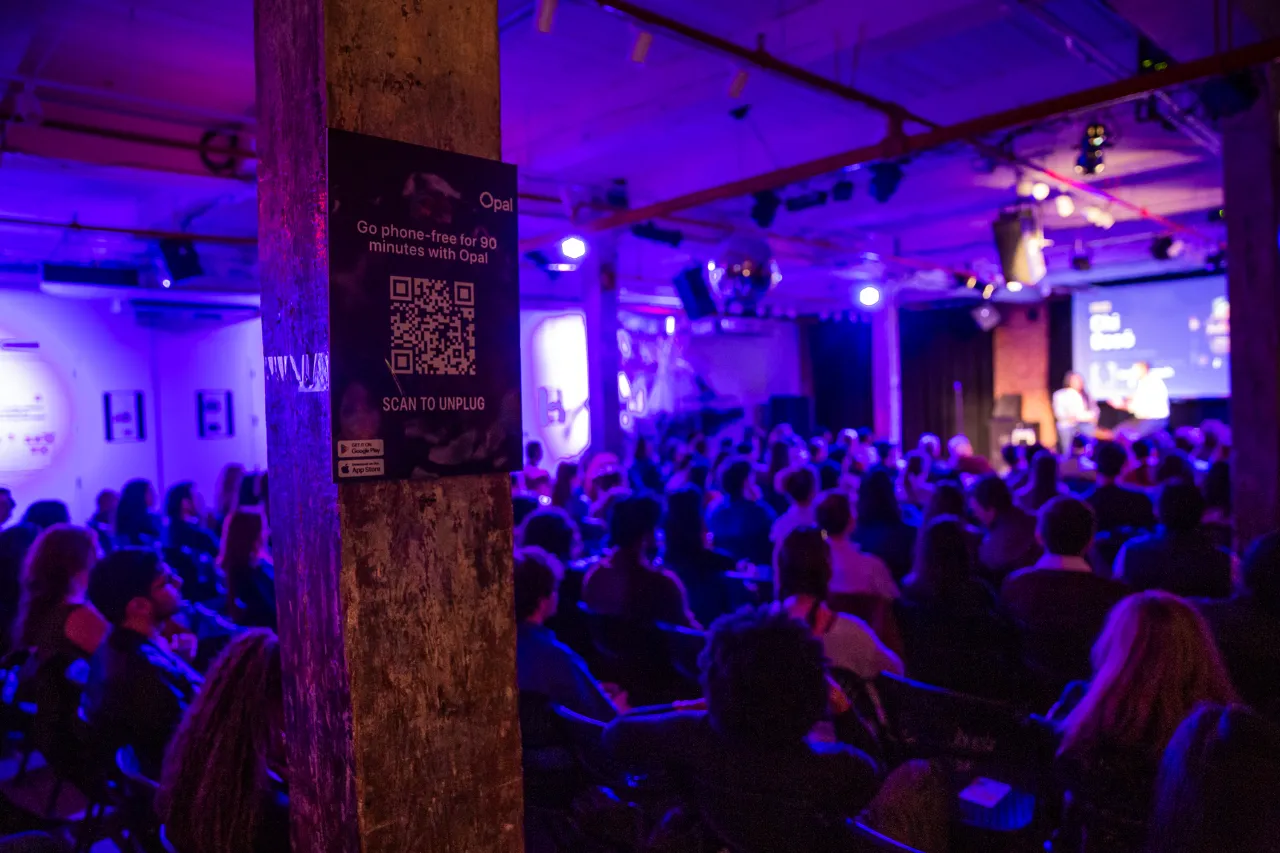
On Thursday night, I donned a pair of neon-yellow high heels and a floral mini-skirt. This is New York, after all—I could wear whatever I pleased to a midterm election event, a gathering packed with media figures, tech industry professionals, and policy advocates—well, who else would even be there? Stepping into a dimly lit, blue-hued warehouse in Brooklyn, I was surprised to find the space already filled to capacity.
The event was hosted by Newsreel—a media company founded by former Forbes and Newsweek journalist Jack Brewster—and featured an impressive lineup. Kenneth Schlenker, co-founder of the focus-enhancing app Opal, took part in a fireside chat on the “state of attention,” while Ayan Bhanjan, developer of the campaign management software Barza, offered predictions on the midterm election results. I, meanwhile, moderated a panel discussion on data centers.
According to Brewster, the goal was to encourage people to “put down their phones and talk to one another about the election” in the final five days leading up to the vote.
Yet, as the evening unfolded, nearly every conversation gravitated toward a single theme: artificial intelligence, data centers, and the growing backlash against the encroaching dominance of technology.
As a tech journalist, I’ve recently noticed an ever-widening chasm between the tech world and the rest of society. I spend most of my days interacting with people who see the benefits of AI, work ambitiously to develop it, and remain firmly confident in its success—so much so that when I speak with those outside the tech bubble, I’m often struck by how bleak and unappealing AI appears through their eyes. Beyond the confines of the tech industry, data centers and artificial intelligence have emerged as significant campaign issues—ones that could even sway the outcome of the November 3rd midterm elections.
A recent report from Data Center Watch indicates that nearly $200 billion worth of data center projects have been delayed, stalled, or blocked—with impacts extending into the first half of 2026—due to political and community opposition. Meanwhile, states including Pennsylvania, Georgia, Texas, New York, and Virginia are considering stricter regulations and greater transparency regarding the rapid expansion of data centers. In Virginia alone, where hundreds of new data centers are in the planning or construction phases, the state has earned the title of “data center capital of the world.”
Before joining a panel discussion, I held a fireside chat with New York City Council Member Chi Ossé, which set the tone for the entire conversation. Artificial intelligence was brought up toward the end; Ossé noted that he does not really use the technology himself. That said, he appeared neither explicitly for nor against AI. His primary emphasis was on holding tech executives more accountable and ensuring that multi-billionaires—like Elon Musk—pay higher taxes. While he identifies as a democratic socialist, he also describes himself as a proponent of “law and order.” He remarked that when CEOs discuss a technology with the potential to cause the extinction of 10% of the human population, “they should be subpoenaed to testify before Congress.”
Next, it was my turn to moderate a panel discussion. I explored the issue of data centers with Maia Woluchem, a researcher specializing in technology and human rights, and Hilary Flint, an advocate for environmental and public health. Upon taking the stage, I decided to first gauge the mood in the room. “How many of you here support AI data centers?” I asked—only to be met with an immediate chorus of boos. Our discussion spanned a wide range of topics and sentiments. The source of the frustration is that big tech companies appear to be striking secret deals with local officials to construct multi-billion-dollar data centers. In some instances, due to zoning restrictions, the public often doesn’t learn what is being built until it is already too late.
Meanwhile, as people struggle with the rising cost of living—clinging desperately to what remains of the American Dream—tech leaders are talking about artificial intelligence replacing workers, or even humanity itself. Residents feel they have lost control over their own communities, and they harbor deep concerns about risks to their environment and health. The panel of experts agreed that data centers have become a tangible embodiment of the fear and anger people feel toward the tech elite and the breakneck pace of technological advancement.
When I pointed out that some communities have actually benefited from the construction of data centers, Flint countered: “What is the value of a life?” She explained that people would still protest, because they “value their own lives more than any temporary gain.”
The panelists who followed my remarks included NewsNation host Batya Ungar-Sargon, political strategist Morris Katz—who worked on Zoran Mamdani’s campaign—and Astead Herndon of Vox. Although the discussion was intended to focus on the future of the Democratic Party, the conversation once again turned to data centers. Ungar-Sargon noted that some labor unions support data center projects because they promise to create jobs. (Reports indicate that while data centers do generate a significant number of jobs during the initial phase, these positions cannot be sustained once construction is complete.)
“In some Rust Belt communities, people used to take pride in the large, unsightly structures in their towns—because that’s where everyone worked,” she said, nodding in acknowledgment of my earlier comment about the ugliness of data centers. “They understood that these buildings represented their own prosperity, stability for their children, the future, and a piece of the American Dream.”
Herndon pointed out that Vivek Ramaswamy was booed when he expressed similar views in Ohio—a “Rust Belt” state. “I just want to highlight this lack of consensus,” he said, “because it’s something that really exists among Republicans in those places—I’ve seen it firsthand.” Katz was also skeptical. “These are the very people who stripped away so many union jobs,” he said. “It’s these institutional powers that have deprived laborers and working people of their jobs and their share of the profits. Now they’re back—essentially to finish the job and sweep up whatever scraps remain.”
On the walls of the warehouse, I noticed several sticky notes with answers to questions like, “Can we get big money out of politics?” “God, I hope so,” one of them read.
After the panel discussion, the crowd headed toward the bar as high-energy electronic music began to play. People gathered in small groups, and the topics of artificial intelligence and data centers came up again—this time in private conversation. I asked Brewster if he was surprised that so much of the discussion had centered on AI and data centers.
“It came up in every single panel, and it was the second most frequent topic among the questions people submitted when they RSVP’d,” he said, adding that this trend was even visible in New York, where data centers aren’t exactly a prominent feature of the landscape. “AI has become an election issue that resonates with ordinary voters,” he noted. “In rural areas, the resistance stems from a fear of being displaced. In places like Brooklyn, the concern is more about who stands to profit from it.”
Before leaving, I asked a few people about the craziest thing they’d seen in the tech world this year. Two tech founders mentioned the AI assistant startup Instinct, while someone from outside the tech industry brought up Sam Altman.
Another person—also from outside the tech sector—pointed to the rise of deepfakes and AI-generated art. She remarked that AI art is starting to feel cheap. This may explain why luxury brands are moving in the opposite direction: Prada’s holiday campaign features hand-drawn illustrations, while Hermès has been highlighting artists’ handmade creations on its Instagram.
While out and about, I got to talking with a software engineer. She mentioned that the craziest thing she’d seen this year was someone painting their nails orange for Halloween—prompting a question about whether it was a nod to Anthropologie’s IPO. I have to admit, I once wore a burnt-orange dress and, for a while, felt like I looked just like the Claude logo.
She later told me that data centers were also springing up in her hometown in Southern California. Hearing this, I began to wonder for the first time how I would feel if data centers were built in my own hometown. She grew up in a Chinese immigrant community, where neighbors had put up signs in their yards depicting a giant dragon with its claws around the throat of a data center.
She mentioned that these signs had since been translated into other languages.